
3 November 2026
Roofers In Summerbridge, Dacre Banks And Darley: Prices, Gritstone, Brick Estates And Planning
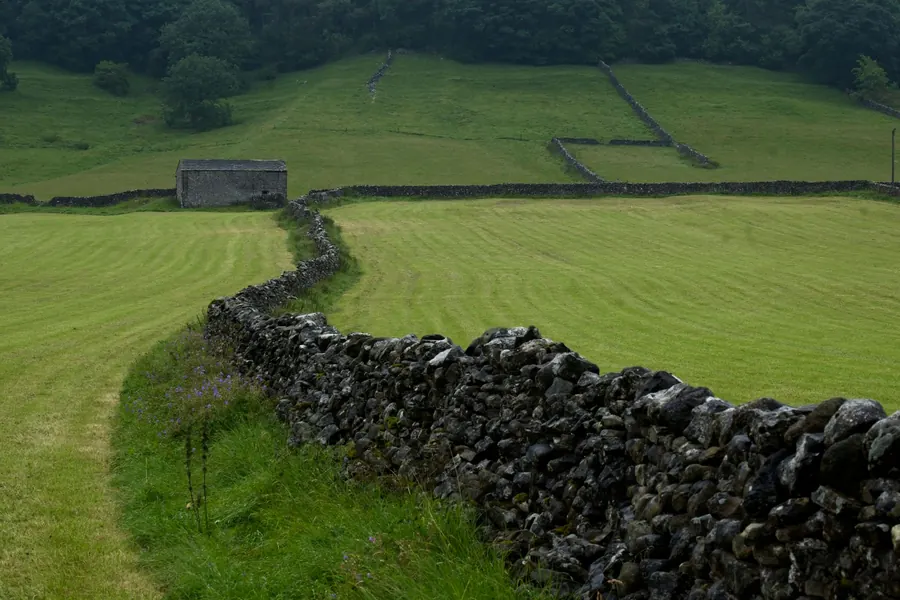
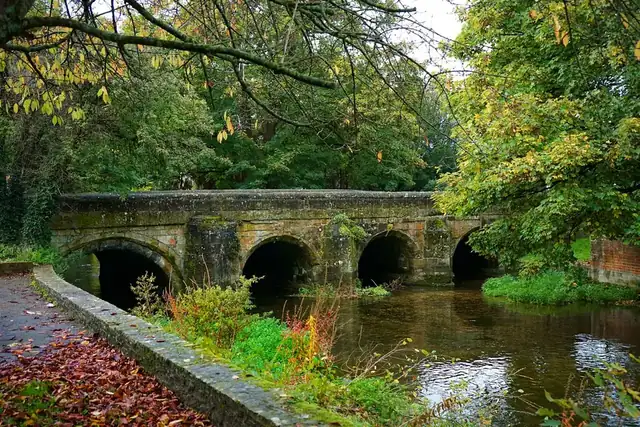
Get quotes from roofers in Summerbridge, Dacre Banks or Darley and the people who turn up will usually have driven out from Harrogate, Ripon or Otley. What they find is a more mixed set of roofs than the postcard view suggests. Summerbridge and Dacre Banks face each other across the Nidd, joined by a two-arched stone bridge, and Darley strings out for about a mile along Darley Beck a couple of miles to the south. The council’s 2004 landscape assessment for this stretch of valley gives the traditional building material as local gritstone with stone slate roofs, and notes that recent development in the villages uses brick. Both turn up in roughly equal measure. A 17th-century farmhouse can sit a few hundred yards from a 1980s cul-de-sac. All three villages are inside the Nidderdale National Landscape and none has a conservation area, which is the opposite of what most owners guess. This guide covers the roofs, the valley, 2026 prices and the planning rules, in that order.
What roofers in Summerbridge, Dacre Banks and Darley find on the roofs
The old buildings are easy to spot. In Dacre parish, the listed farmhouses, cottages and barns are gritstone, and most of them carry stone slate. The Royal Oak in Dacre Banks, dated 1752, is one of them. There are exceptions. Holy Trinity Church, built in 1837, has a purple slate roof, and Pyefield House and Oxen Close are grey slate. Over the river in Hartwith cum Winsley parish, which takes in Summerbridge, the mix of stone slate and blue or grey slate is much the same.
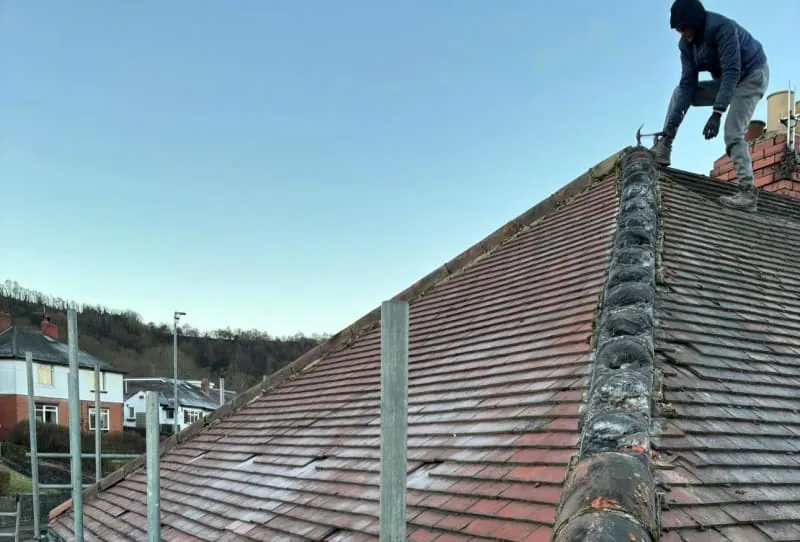
What people don’t expect is how much of the housing is newer. Summerbridge grew as a compact village around its mills and has filled in since the war, and Darley has added houses along its length. Most of those are brick or reconstituted stone under concrete interlocking tiles. These roofs don’t need the specialist skills of a stone slate roof, but they have their own failure points. Mortar-bedded ridges, like the one in the photo above, and the verges below them crack after 30 or 40 winters. Chimneys get neglected because no one burns coal any more, and the felt along the eaves perishes until the bottom course of tiles starts to rot the fascia. When a roof replacement is due on one of these houses, it’s usually a straightforward strip and re-cover. The old felt, battens and mortar come off, and a breathable membrane goes on with new battens and dry-fix ridges and verges.
On the older buildings, the work is slower and more careful. Stone slates are sorted, numbered by size and relaid in diminishing courses, and anything broken gets matched from reclaimed stock. That difference in pace is the biggest single reason a quote for a stone cottage looks nothing like a quote for the semi next door.
Two villages on opposite sides of the river
Summerbridge and Dacre Banks are a few minutes’ walk apart, but their roofs live in different conditions. Summerbridge sits on the north bank, with the ground rising behind it towards Brimham Rocks, so many of its slopes face south and get whatever sun there is. Dacre Banks is on the south bank. Behind it the land climbs to the hilltop village of Dacre, so the houses built up that bank tend to have their main slopes facing north.
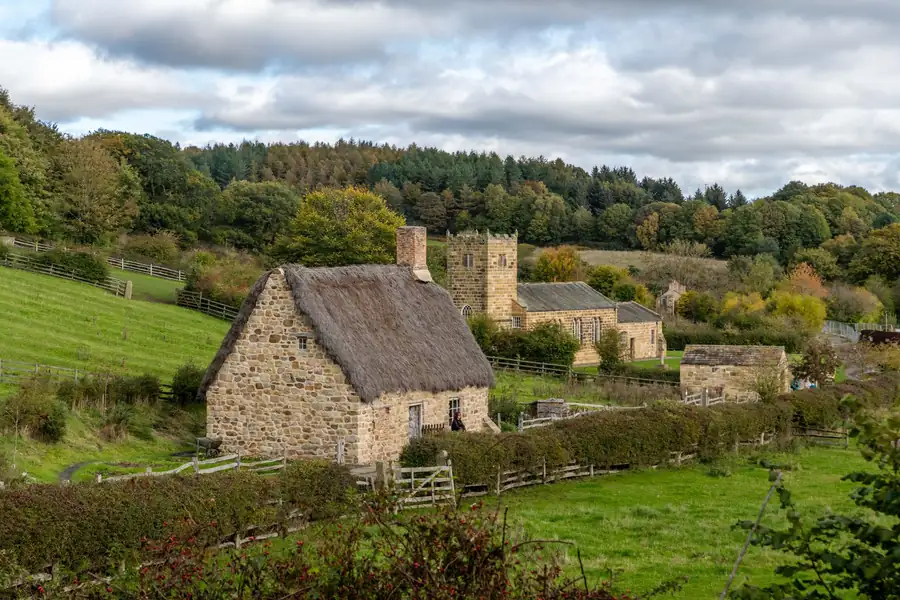
A north-facing stone slate roof in a wooded valley is about the slowest-drying surface you can build. Lichen and moss take hold faster, the lime pointing at the verges stays damp for longer, and frost gets more chances to work into the gaps. A south-facing roof across the river has the opposite problem in summer, with mortar beds and lead getting more heat and movement. Neither is worse, but they wear out in different places. On a north slope we’d look closely at the slate tails and the oak pegs. On a south slope we’d check the ridge bedding and the lead at the abutments first.
The valley shape adds to it. The landscape assessment describes a broad, U-shaped valley running from about 70 metres above sea level on the floor to 330 metres on the rim, with heavy woodland on the valley floor. Braisty Woods lies just north of Summerbridge, and there is ancient woodland at Low Hall Wood and around the old Darley Mill site too. Trees keep the wind off. They also hold moisture in the air and drop leaves and twigs into every gutter for six weeks each autumn.
Mills, chapels and a thatched house at Darley
The larger villages in this stretch grew at river crossings that once powered mills, and some of the most awkward roofs in the area are on former industrial buildings. Darley Mill, at the western end of the village, is a Grade II listed corn mill range in gritstone with a stone slate roof, a large waterwheel at the rear and a truncated chimney. Darley Mill House beside it is dated 1767. Hartwith Mill, an early to mid 19th-century gritstone mill now converted to a house, keeps a mix of grey slate and stone slate. In Summerbridge the landscape assessment picks out the old mill buildings and millponds, and the small industrial estate at New York sits on the edge of the village.
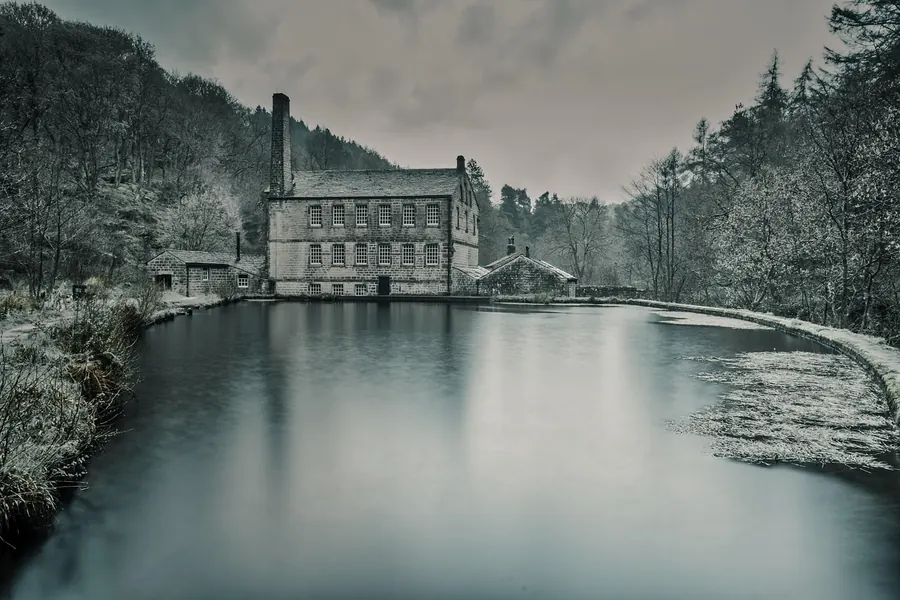
Mill roofs are long, often shallow and wide in span, and many were patched over the decades with whatever was cheapest. On conversions we often find stone slate on one slope and Welsh slate on the other. There can also be lead flats where an internal gutter used to run, and rooflights that were added without much thought for the rafters. Pricing them properly needs a loft inspection and usually a scaffold survey, because what’s under the slates often explains why the ceiling keeps staining.
Darley also has something you won’t find many of in this part of Yorkshire. The Holme, at the eastern end of the village, has a timber-framed core from around 1500 that was cased in gritstone in 1667, and it is thatched. If you own a thatched roof, you need a thatcher, not a roofer. We’d happily look at the leadwork or the chimney on a building like that, but the thatch itself is a separate trade. The Wesleyan chapel of 1829 is more typical of the parish, with gritstone walls and a stone slate roof, and so are its farmhouses, such as Fringill Top and Day Ash House.
Roof prices in Summerbridge, Dacre Banks and Darley for 2026
These figures are what we’d expect to quote in the lower dale this year. Each one includes scaffold where the work needs it, and VAT. Your roof will have its own quirks, so use them to judge whether a quote is in the right area, not as a fixed price.
Brick and reconstituted stone houses from the 1960s onwards
The bread-and-butter jobs. Repointing or dry-fixing a ridge runs from £450 to £1,100. New uPVC fascias, soffits and guttering on a semi cost roughly £1,800 to £3,200. A full strip and re-cover in concrete tiles is usually £7,500 to £12,000, and switching the same house to natural slate adds around £2,500 to £4,500.
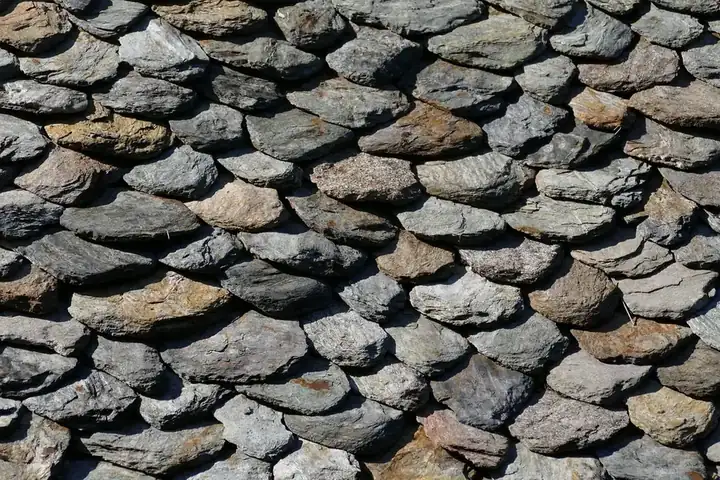
Stone cottages and farmhouses with stone slate
Refixing a handful of slipped stone slates is £200 to £500. Taking down and rebedding a ridge in lime mortar costs £650 to £1,500, depending on length and how many ridge stones are cracked. A full strip and relay with the old slates sorted and topped up from reclaimed stock is priced after a survey. On a two-storey cottage it commonly lands somewhere between £18,000 and £36,000. The spread comes down to how many slates survive and whether the timbers need work.
Outbuildings, garages and extension roofs
A few listed barns in Hartwith cum Winsley parish still carry corrugated asbestos cement sheets, and plenty of unlisted sheds and garages do too. Removing and disposing of an asbestos sheet roof on a single garage or small barn by a licensed route, then re-sheeting, typically costs £1,800 to £4,000. A new EPDM or GRP flat roof on a single-storey extension of around 15 square metres comes in at £1,600 to £3,000.
Planning in the lower dale: inside the National Landscape, outside any conservation area
Since 1 April 2023, North Yorkshire Council has handled planning, building control and listed building consent for all three villages, taking over from Harrogate Borough Council. None of them is on the council’s list of conservation areas for the former Harrogate district. The nearest is Glasshouses, a short way upstream. That surprises owners of the older cottages, who often assume they’re covered.
What does apply is the Nidderdale National Landscape, designated as an Area of Outstanding Natural Beauty in 1994 and renamed in 2023. The National Landscapes Association’s page on Nidderdale gives the background. For roof work, the practical effect is that land inside it loses some householder permitted development rights. A dormer, a raised ridge or any roof extension needs a planning application, even on a rear slope no one can see from the road. A like-for-like re-roof, repairs and most rooflights do not.
Two more things to check before you plan anything bigger than a repair. First, listed buildings. Dacre parish has 16 and Darley and Menwith parish has 12, all Grade II, and any change to the roof covering or its details will need listed building consent. Second, newer houses. A planning permission for an estate or a single new house can remove permitted development rights by condition, especially in protected landscapes. If you’re thinking about a loft conversion, look up the original decision notice through North Yorkshire Council’s planning applications search before paying anyone for drawings. The council’s landscape character assessment for the Summerbridge to Birstwith stretch of the valley is also worth a read. It asks for new buildings to respect the local vernacular and for traditional buildings to be repaired rather than left to decay, and planning officers still lean on it.
Leaves, becks and the riverside streets
Gutters do more work here than on an open hillside. Becks feed the Nidd and Darley Beck from every side of the valley, the soils over clay are slow to drain, and the trees shed hard in October and November. A blocked gutter on a gritstone cottage doesn’t just overflow. It soaks the top of the wall, the water finds its way into the timber wall plate and, over a few winters, the rafter feet start to soften.
For a house under trees, one clear-out a year usually isn’t enough. Do the gutters, hoppers and valleys once the leaves are down, which is normally late November, and again in spring if there are conifers nearby. Leaf guards help only if they lift off easily, because moss and catkins clog them as well. The places people forget are behind parapets and on the back of chimney stacks, where debris piles up out of sight. And follow the downpipes to the ground. If one empties onto the wall footing rather than into a gully or soakaway, that’s a damp problem waiting to happen.
Riverside houses have one extra thing to think about. The Environment Agency’s flood warning area for the River Nidd at Summerbridge and Dacre Bank covers properties along the riverside and Thomas Gill Road in Summerbridge, and along the B6451 and Church Avenue in Dacre Banks. A roof job on one of those streets is no different in itself. What changes is where the scaffold stands and when. A base on low ground next to the river is planned around the forecast, not just the diary.
Getting a roofer out to the lower dale
The villages are easy to reach compared with the top of the dale. The B6165 from Ripley runs up the north side of the valley through Summerbridge, and the B6451 crosses the river there and climbs past Dacre Banks towards Darley Head. That makes deliveries simpler than in Pateley Bridge or beyond. Even so, some of the lanes up to Dacre and the farmsteads above Darley are narrow and walled, and a full-size scaffold wagon can’t always turn at the top. For the ground-level detail on the villages the other side of Burnt Yates, our guide to roofers in Ripley, Burnt Yates and Markington covers the next stretch down the B6165.
When you collect quotes, check that each one says the same things in writing:
- which slopes and features are included, and whether the chimney is part of it
- the scaffold height, how long it stays up and whether it needs a highway licence on a narrow street
- what happens to sound stone slates, and who keeps them
- whether listed building consent or planning is needed, and who applies for it
- the guarantee, and what it covers
Book spring or early autumn for anything involving lime mortar, so it has time to cure before the frosts. Repairs and making a leak safe can happen at any time of year.
If you’d like us to look at a roof in Summerbridge, Dacre Banks or Darley, we’ll check the loft as well as the outside, tell you whether the building is listed and send a written, itemised quote. Book a free roof survey in Nidderdale.
Frequently Asked Questions
Is Summerbridge, Dacre Banks or Darley in a conservation area?
No. None of the three appears on North Yorkshire Council’s list of conservation areas for the former Harrogate district. The nearest one is Glasshouses, a couple of miles upstream towards Pateley Bridge. All three villages are inside the Nidderdale National Landscape, though, and that carries its own limits on roof extensions.
Can I put a dormer on my house in Darley or Summerbridge without planning permission?
No. Because both villages sit inside the Nidderdale National Landscape, a dormer or any other roof extension falls outside permitted development and needs a planning application from North Yorkshire Council. Rooflights that sit close to the slope and a like-for-like re-roof normally don’t need one. On newer estates it is also worth reading the original planning decision notice, because some permissions remove householder rights by condition.
Do I need consent to repair a listed building in Dacre or Darley?
Listed building consent is needed for any work that affects the building’s character, and changing the roof covering or its details almost always counts. A straight repair in matching materials, such as refixing stone slates or relaying lead to the same pattern, often doesn’t. The judgement belongs to the council’s conservation officers rather than to the roofer, so ask them before work starts. Every listed building in Dacre parish and in Darley and Menwith parish is Grade II.
How much does it cost to re-roof a brick house in Summerbridge or Darley?
For a three-bedroom semi or detached house from the 1960s onwards with a concrete tile roof, a full strip and re-cover with scaffold, new membrane and battens usually comes to £7,500 to £12,000. Swapping to natural slate adds roughly £2,500 to £4,500 on the same house. Detached houses with hips and valleys sit at the top of that range.
Does living on Thomas Gill Road or Church Avenue affect roof work?
Both streets fall inside the Environment Agency’s flood warning area for the River Nidd at Summerbridge and Dacre Bank. Flooding doesn’t damage roofs, but where your downpipes and gullies discharge does matter, and a scaffold base on low riverside ground has to be planned around the forecast. We ask about it at the survey.