
28 October 2026
Roofers In Ripley, Burnt Yates And Markington: Roof Costs, Estate Stone And Planning
Roofers in Ripley, Burnt Yates and Markington are dealing with three very different villages inside a few miles of each other, north-west of Harrogate. Ripley is a castle estate village that was pulled down and rebuilt to a single plan between 1820 and 1840, and every building on its Main Street and Market Place is now listed. Burnt Yates is a cluster of about fifty houses on the Pateley Bridge road, sitting at roughly 145 metres, close to twice the height of Ripley at around 74 metres. Markington, about three miles north of Ripley, is a working village of gritstone, limestone and cobble, where pantile roofs often keep three courses of stone slate at the eaves. That mix decides what a roof job costs, what you can change and who has to agree to it first. This guide covers 2026 prices, the roofs you will find in each village, the weather on the higher ground and the paperwork after North Yorkshire’s 2023 reorganisation.
Ripley: roofs on an estate village built to one plan
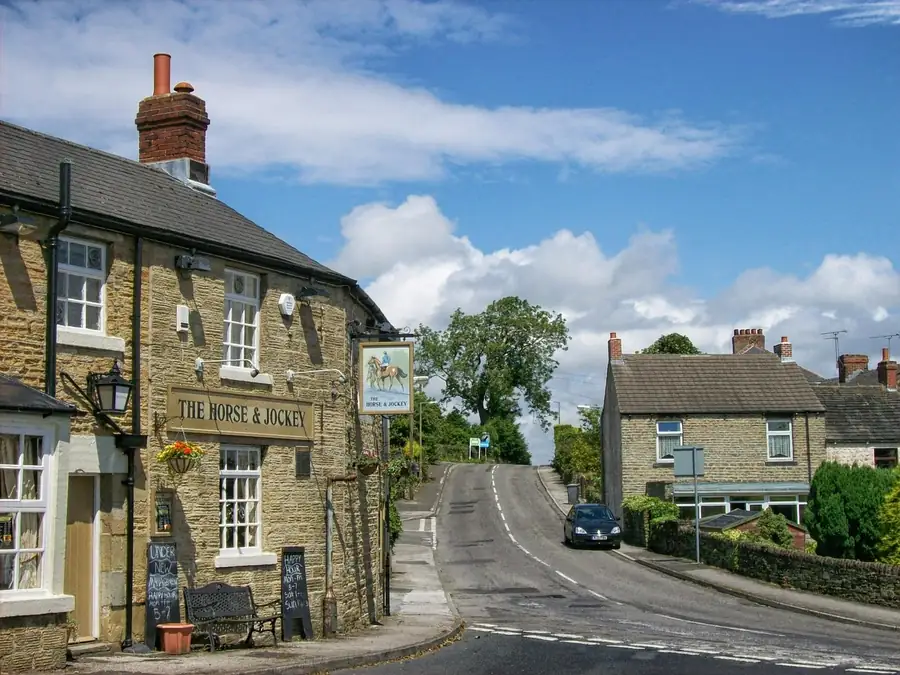
Ripley has been an estate village for centuries, but what you see today is mostly the work of one man. Sir William Amcotts Ingilby rebuilt it between 1820 and 1840, modelled on a village he had seen in Lorraine, and he gave the cottages pointed windows and Tudor-style doorways. The council’s character appraisal notes that the fancy detail is on the front. The backs are plain.
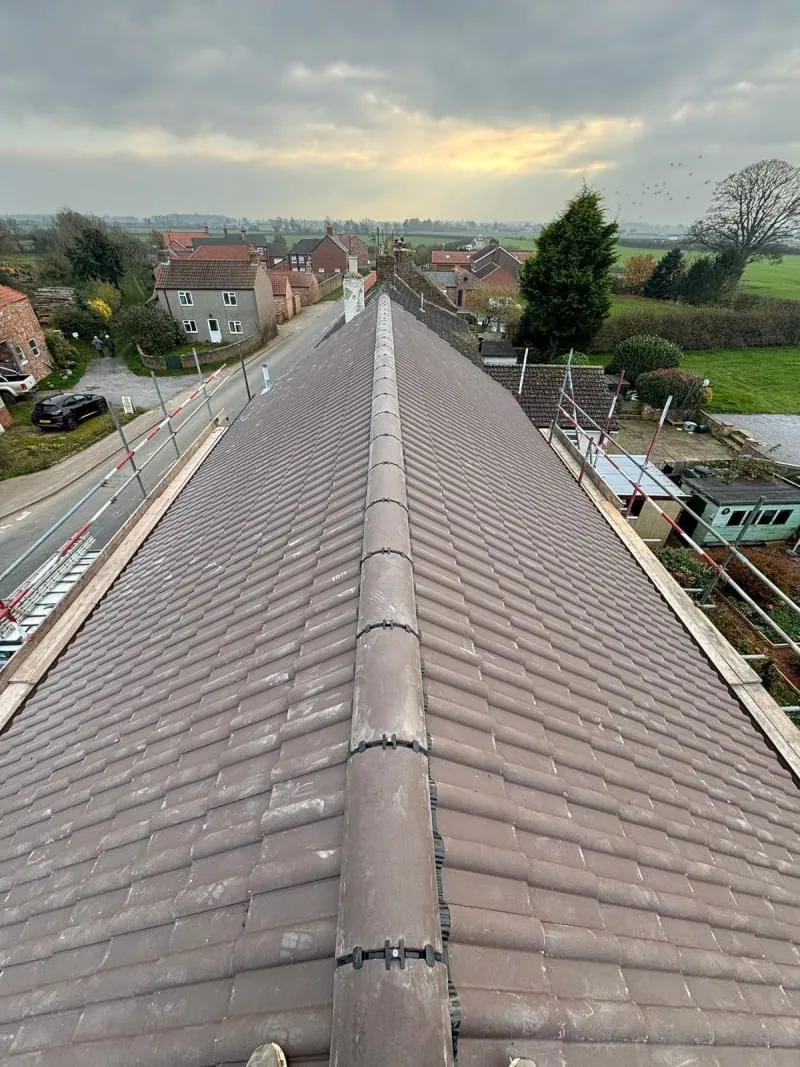
For a roofer, the interesting part is the variety packed into one short street. Most of the houses along Main Street have hipped roofs in grey slate, some laid in graduated courses with the biggest slates at the eaves and the smallest near the ridge. A couple are in green-grey Westmorland slate. The roofs of Town Hall Cottages at the north end are really a row of big dormers running back into a cross roof, which means valley gutters and stacks on the ridge. At South View, the gables run front to back with a tall chimney in each valley. Estate Cottages and a few detached houses hide their eaves behind a shallow stone parapet, and the terraces south of the Hotel de Ville have deep overhanging eaves instead.
Every one of those details is a place where water collects or wind gets a grip. Hips need their hip irons and bedding checking. Valleys and parapet gutters need their lead looking at. A tall stack standing in a valley takes the full force of the weather and sheds all of it into the gutter below. Graduated slating can’t be patched with whatever comes off the van, either. A replacement slate has to match the size of the course it sits in. If something has already moved, our roof repairs page explains how we find the actual cause before pricing a fix.
Pantiles appear in Ripley, but only on the smaller farm buildings and outbuildings along Orchard Lane.
Listed building consent and the Ripley conservation area
Ripley is a conservation area, and its Ripley conservation area character appraisal was approved on 25 November 2009. It’s blunt about roofs. Rooflines and ornate chimney stacks are singled out as especially important, and big changes to the roofline, poor materials, intrusive dormers or unsuitable roof windows “will not be acceptable”.
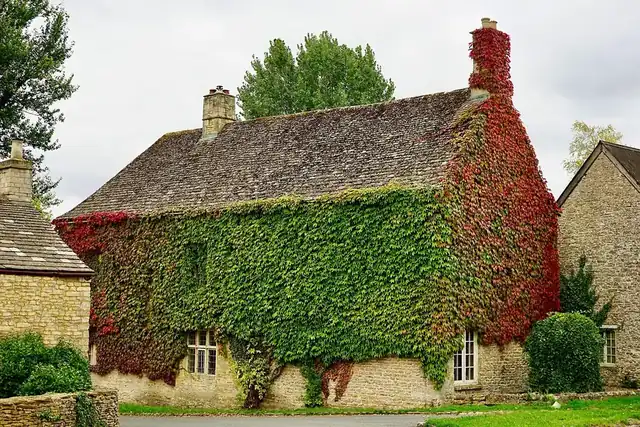
On the main street the conservation area matters less than you might think, because the listing covers most of it already. Every building facing Main Street and the Market Place is listed. Ripley Castle and its gatehouse are Grade I, and All Saints’ Church is Grade II*. On a listed cottage, changing the slate, adding a rooflight or taking down a chimney needs listed building consent, and even a large like-for-like re-roof should be talked through with the council’s conservation officer before the scaffold goes up. Small repairs in matching materials don’t usually need consent, but get that confirmed in writing for your own building.
There’s no Article 4 direction in Ripley. North Yorkshire Council’s list of conservation areas in the Harrogate district says the only ones are in Great Ouseburn and parts of Harrogate. For an unlisted house inside the boundary, the usual conservation area rules apply. A dormer facing the road needs planning permission, and the council will judge it against the appraisal and the 2004 Ripley Village Design Statement.
All of this now goes through North Yorkshire Council, which replaced Harrogate Borough Council on 1 April 2023. The same council handles building control.
Markington: pantiles that keep their stone slate eaves
Markington is a working village rather than an estate one. Its parish, which also takes in Wallerthwaite and Markenfield Hall, had 629 people at the 2011 census. It isn’t a conservation area, and it isn’t in the Nidderdale National Landscape. It does, however, have 13 listed buildings, and their list descriptions show just how mixed the local roofs are.
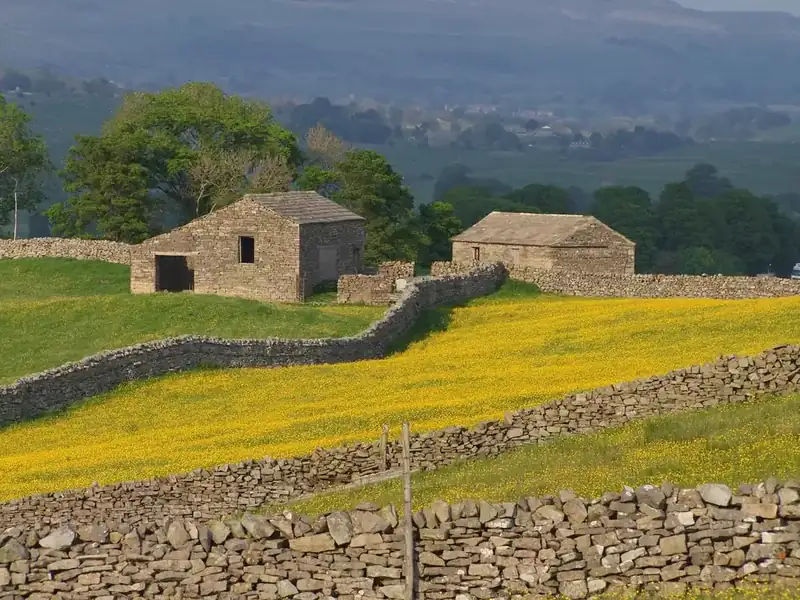
Markington Hall and Park House have stone slate roofs. St Michael’s Church, built in 1843-44, and Low Mill are covered in Westmorland slate. Church Farmhouse has purple slate. Rigg House Farm, Foal Cote House and Brook House have pantiles. Hincks Hall has a pantile roof with three courses of stone slate along the bottom, and the late medieval barn east of Markington Hall also has stone slate eaves courses under its pantiles.
That stone slate strip isn’t decoration. Pantiles are light and hang on battens. A few courses of heavy stone at the eaves sit firmly on the wall head and throw rainwater clear of the masonry, which matters on walls made of rubble, cobble and soft limestone. When a pantile roof like this is re-covered, the eaves courses should be lifted, sorted and re-laid, not swapped for an extra row of tiles. On a listed building it is part of what the listing protects. On an unlisted barn or cottage it still does a job.
The walls are mixed too. Several buildings combine gritstone with limestone, and some have cobble panels. Hard cement pointing traps water in limestone, so ask how your roofer plans to repoint the chimney and the gable tops. Lime mortar is usually the answer. Markington sits roughly four miles from Ripon, and our Ripon roofing page covers the city side of the area if you are comparing quotes.
Burnt Yates: higher ground on the Pateley Bridge road
Burnt Yates lies less than two miles west of Ripley on the B6165, the road up Nidderdale to Pateley Bridge. It’s small, at around fifty houses, and it sits about a mile north of the River Nidd, at roughly 145 metres.
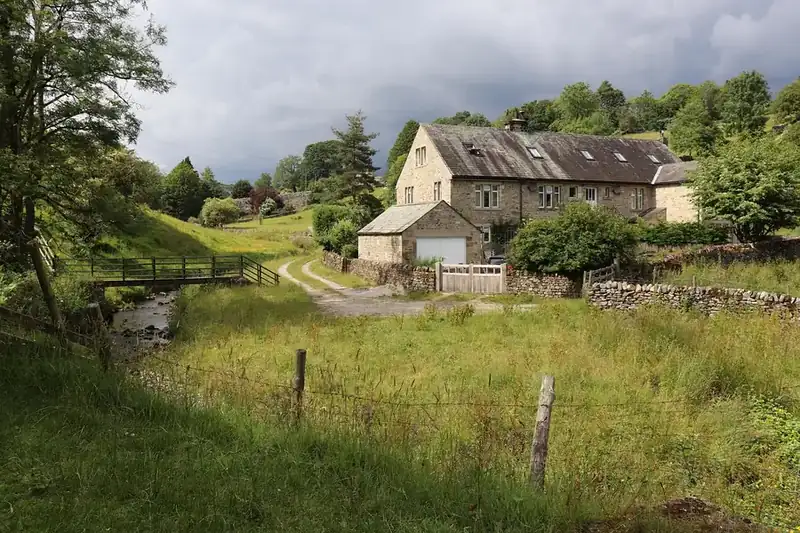
The height makes a difference. Ripley sits lower, beside the castle park. Burnt Yates is up in the open, with the land rising towards the dale, and the prevailing west and south-west winds hit it without much to slow them. Gable ends take most of that. Rose Lea Farmhouse, one of the listed buildings, has coped gables, and so do plenty of older stone houses in the district. On a coped gable, stone tabling runs up the verge and the slates tuck in under it. When the mortar under those copings fails, water runs straight down inside the wall. It shows up as damp on a bedroom gable, and people often blame the slates when the real problem is the coping.
The listed buildings show what the village was built from. Burnt Yates School, dated 1760 with additions in 1763 and 1849, is gritstone with stone slate on the older parts and blue slate on the newest extension. Rose Lea Farmhouse, from the early to mid 19th century, is gritstone under stone slate. Stone slate on the old work and blue slate on the new is a pattern you see all over this part of the district, sometimes on one building.
Burnt Yates isn’t a conservation area, and the government’s planning map puts it just outside the Nidderdale National Landscape, with the boundary a short way to the west. Birstwith, a couple of miles to the south-west, is inside it. So permitted development rights work normally on an unlisted house here. If you are planning a dormer or a big change of material, check the boundary for your own address on the council’s map rather than going by the village name.
Roof costs in Ripley, Burnt Yates and Markington for 2026
The same job can cost noticeably more in Ripley than in Markington, mostly because of listing, slate matching and access on the main street. These are guide prices including VAT, for ordinary houses with sound timbers:
| Job | Guide price, 2026 |
|---|---|
| Refixing a few slipped slates, matched to a graduated course | £180 - £450 |
| Rebedding and refixing the hips on a hipped slate roof | £300 - £750 |
| Relining a lead valley or parapet gutter | £900 - £2,200 |
| Repointing or rebuilding a tall chimney stack in lime | £1,400 - £3,500 |
| Re-covering a pantile outbuilding, keeping stone slate eaves | £4,500 - £9,000 |
| Re-roofing a post-war house in concrete tiles | £6,500 - £10,500 |
| Re-slating a hipped listed cottage in matched slate | £11,000 - £20,000 |
| Scaffolding, including any licence on the road | £800 - £1,800 |
The top row has a wider spread than it looks. Graduated slates come in many sizes, and finding second-hand ones to match a particular course can take longer than fitting them. For a listed cottage, add time for the consent before any of these figures apply. A roofer who leaves consent out of a Ripley quote has either checked already or hasn’t thought about it, so ask which.
Newer concrete-tiled houses usually come in at the lower end. There’s rarely a consent question, and the tiles are easy to get.
Getting scaffold and materials into the villages
Ripley’s main street was widened a lot when it was rebuilt, so the front of most cottages can take a scaffold without much drama. The back is another story. Back Lane and Orchard Lane are narrow, lined with stone walls and outbuildings, and a lorry that can reach Main Street won’t always get round to the rear. The castle and its gardens also bring a steady stream of visitors and weddings through the village, and the visitor car park sits at the south end. A scaffold on the public road needs a licence from North Yorkshire Council as highway authority, and it’s worth timing the job to avoid the busiest weekends.
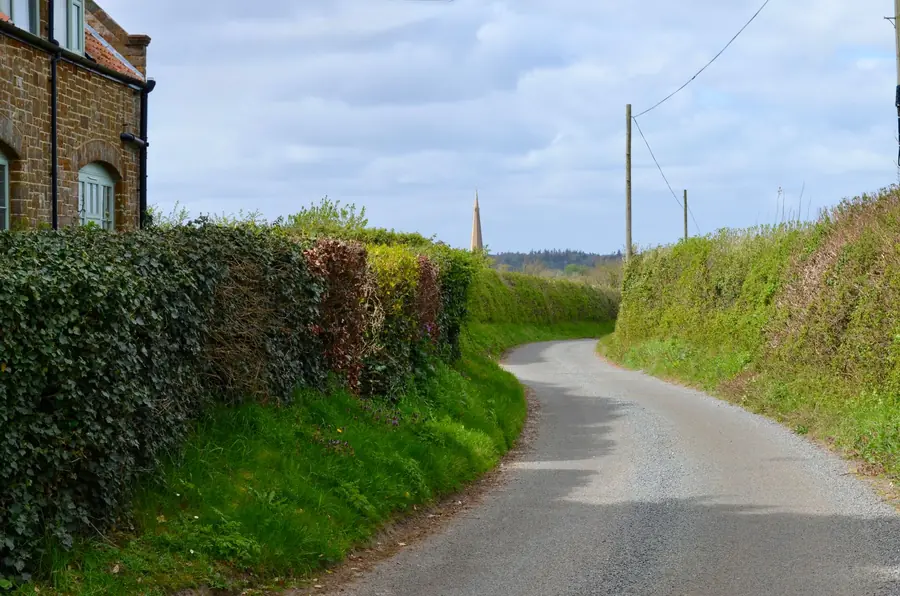
In Burnt Yates the problem is traffic rather than width. Houses along the B6165 face a fast road, so a scaffold there may need lights or barriers, and materials are best dropped early in the morning. Around Markington, the farmhouses and barns down tracks are usually easier to scaffold than they look, but a full load of stone slate or reclaimed pantiles needs somewhere firm to land. Ask the roofer to visit before quoting, not price from a photo.
A few questions to ask before you book:
- Will the slates or tiles that come off be reused, and roughly what share do you expect to be sound?
- On a listed building, who applies for consent, and is that in the price?
- Is the chimney pointing in lime, and are the lead valleys or parapet gutters included?
- Where will the skip and the materials go, and is a road licence included?
The neighbouring villages a little further down the Nidd have their own mix of conservation rules and National Landscape boundaries, which we cover in our guide to roofers in Killinghall, Hampsthwaite and Birstwith. For the national rules on what counts as permitted development, the Planning Portal’s guidance on roof planning permission is a good starting point.
When you’re ready, book a free roof survey in Ripley, Burnt Yates or Markington and we’ll look at the roof, the timbers and the consent position before giving you a price.
Frequently Asked Questions
Is Ripley a conservation area?
Yes. Ripley is one of the conservation areas North Yorkshire Council looks after in the former Harrogate district, and its character appraisal was approved on 25 November 2009. Every building facing Main Street and the Market Place is also listed, so most roof work on the village street needs listed building consent as well. There is no Article 4 direction in Ripley. The council’s own list says those only apply in Great Ouseburn and parts of Harrogate.
Are Burnt Yates and Markington conservation areas?
No. Neither appears on North Yorkshire Council’s list of conservation areas for the Harrogate district, and the government’s planning map puts both villages just outside the Nidderdale National Landscape. That does not make every house a free-for-all. Markington with Wallerthwaite parish has 13 listed buildings, and Burnt Yates has a listed school and farmhouse, so check your own address before changing a roof covering.
Who approves roof work in Ripley, Burnt Yates and Markington now?
North Yorkshire Council. It took over from Harrogate Borough Council on 1 April 2023 and deals with planning applications, listed building consent and building control for all three villages. Scaffold and skip licences on the public road also go through the council, as highway authority.
What does a new roof cost in these villages?
As a 2026 guide, re-roofing a post-war house in concrete tiles runs from about £6,500 to £10,500, while re-slating a hipped, listed cottage in matched slate is more like £11,000 to £20,000. Re-covering a pantile outbuilding and keeping its stone slate eaves courses tends to cost £4,500 to £9,000. Scaffolding is usually £800 to £1,800 on top.