
16 October 2026
Roofers In Killinghall, Hampsthwaite And Birstwith: Roof Costs, Stone Roofs And Planning
Killinghall, Hampsthwaite and Birstwith are within about four miles of each other on the lower Nidd, all north-west of Harrogate, and yet a roof job in each one can fall under a different set of rules. Killinghall has no conservation area and sits outside the protected landscape. Hampsthwaite has a conservation area that has been in place since 1976. Birstwith has no conservation area but sits inside the Nidderdale National Landscape. For most repairs none of that matters. For a change of material, a dormer or a new roof window, it decides whether you need an application. The roofs themselves differ too. A 1980s estate house off the A61 will take concrete tiles, a Hampsthwaite cottage may have gritstone slates with a stone eaves course, and a Birstwith farmhouse can have both under one ridge. We start with Killinghall, work up the valley and finish with prices.
Roofers in Killinghall: estate roofs and an older core on the A61
Killinghall is the nearest of the three to Harrogate. It runs along the A61 Ripon Road, with Killinghall Bridge taking the road over the Nidd to the north. There’s a strip of older stone houses and cottages along the main road, but most of the village is housing built over the last sixty years or so, and that’s where most of our work there comes from.
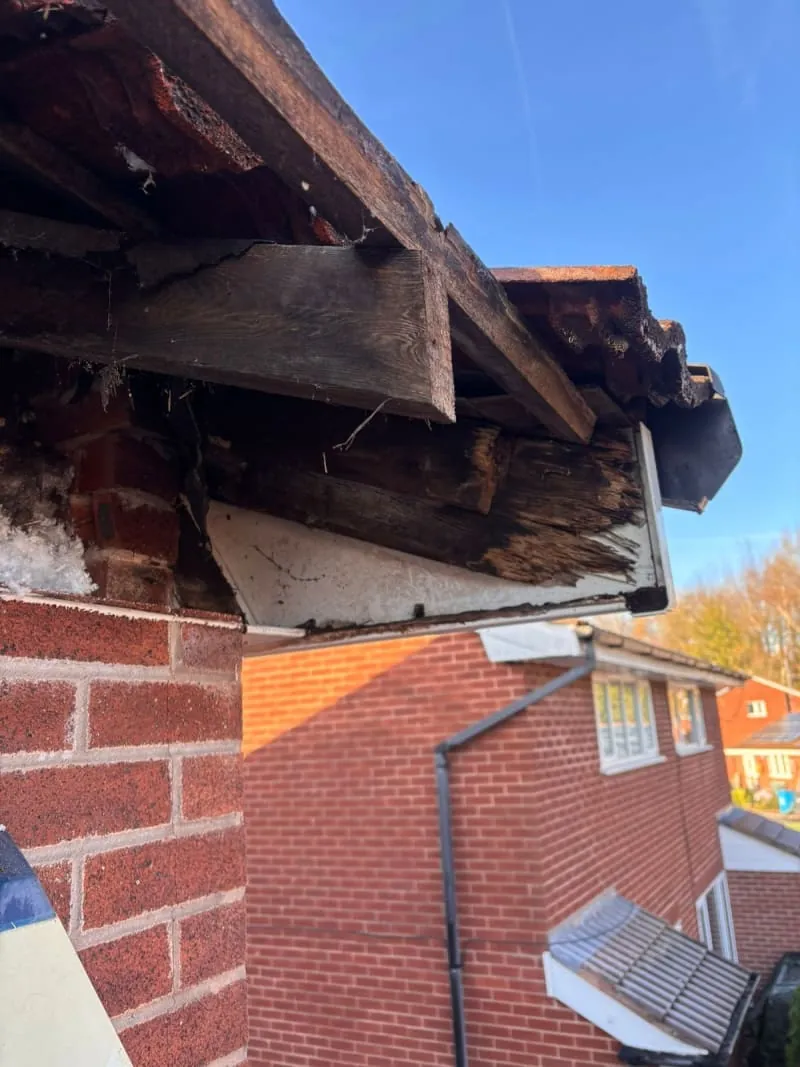
On those houses the trouble usually starts at the eaves, not on the slope. The photo above is typical of what turns up once the old fascia comes off. The rafter feet have soaked up water for years from a blocked gutter or a perished felt strip at the eaves, and the softwood has gone. Concrete interlocking tiles last a long time, but the felt under them and the timber at the edges don’t always last as long. That’s why a “few slipped tiles” call in Killinghall often turns into a quote for new fascias, an eaves carrier tray and a few rafter ends. Our roof repairs page shows how we price that kind of work before anyone starts lifting tiles.
Planning is simple here. Killinghall isn’t on North Yorkshire Council’s list of conservation areas and it’s outside the National Landscape, so a house that isn’t listed has the normal permitted development rights for roof work. That includes rear dormers within the size limits.
Hampsthwaite: the conservation area on the old Roman road
Hampsthwaite is the one with the most rules. The council’s 2009 character appraisal places it five miles north-west of Harrogate, south of the Nidd, and says the original village grew as a line of houses along the Roman road from Ilkley to Aldborough. Its conservation area was first designated in 1976, and the boundary was changed in 1994 and again in February 2009. You’ll find it, with the appraisal, on North Yorkshire Council’s conservation areas page for the Harrogate district.
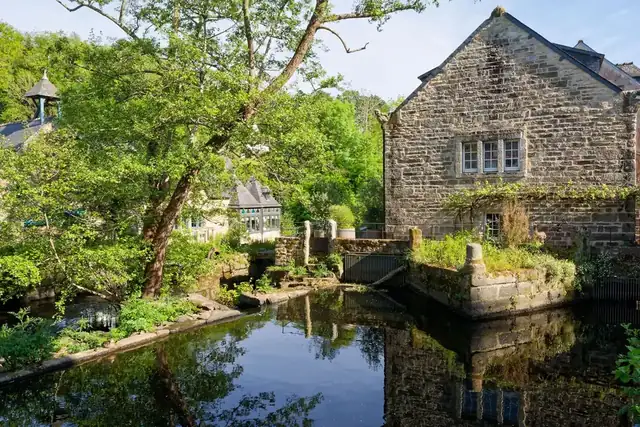
The appraisal is useful to read before you get quotes. It says gritstone is the main building material, in colours from grey to pink, and that the roofs are a mix of stone slate, Welsh slate and some modern tiles. On the steeper roofs you’ll often see a few courses of stone slate along the eaves. The High Street terraces have their chimney stacks on the party walls, and the appraisal points out that roof pitches vary but very few are steep. Those are the details a planning officer will look for if you apply to change anything, so a roofer quoting on a Hampsthwaite cottage should say whether they plan to keep the stone eaves course.
The newer part of the village, along Hollins Lane and the post-war development behind it, is mostly outside the conservation area boundary. The appraisal map shows where the line runs. If your house is on the wrong side of it, the normal rules apply.
Birstwith: inside the National Landscape, with no conservation area
Birstwith is a short way upstream, and it’s the only one of the three that sits inside the protected landscape. We checked Natural England’s boundary data. Birstwith falls inside the Nidderdale National Landscape, while the boundary follows the river close to Hampsthwaite and stays a few kilometres west of Killinghall. The area was designated as an Area of Outstanding Natural Beauty in 1994 and was renamed a National Landscape in 2023. The Nidderdale National Landscape team publishes the management plan and guidance on building in the area.
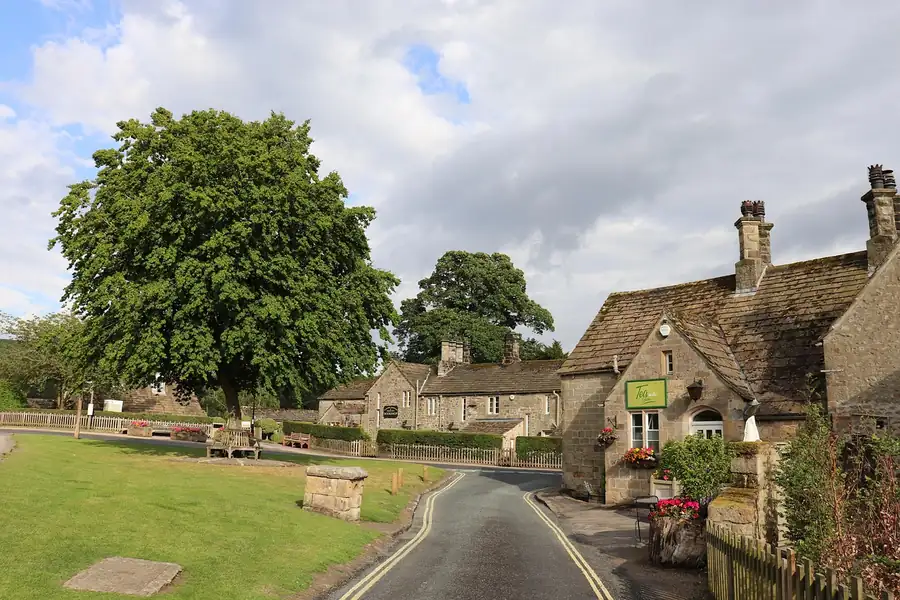
Living inside it doesn’t change much for an ordinary re-roof. Like-for-like replacement still doesn’t need permission. The difference is that land in a National Landscape loses some permitted development rights. Roof extensions such as a dormer loft conversion need a full planning application, and so does cladding the outside of the house. Birstwith isn’t on the council’s list of conservation areas. That surprises some owners, because the older parts of the village look much like Hampsthwaite. Listed buildings still need consent whatever the area, so check the listing before you plan anything on one of the older farmhouses or cottages.
The roofs in Birstwith are much the same as in Hampsthwaite: stone slate on the oldest buildings, Welsh slate on Victorian houses and later rebuilds, and concrete tile on anything built after the war. The difference is the farmland around the village, which brings barns, shippons and outbuildings into our work far more often than in Killinghall.
The valley floor: damp, flood meadows and moss
All three villages sit low in the lower Nidd valley, and that matters more for their roofs than height or wind. The Hampsthwaite appraisal describes the geology as Millstone Grit, with slowly draining, seasonally waterlogged soils on the valley sides. It also names the lower end of Church Lane, down to Hampsthwaite Bridge, as the main area at risk of flooding, along with Cockhill Beck, which runs behind the High Street.
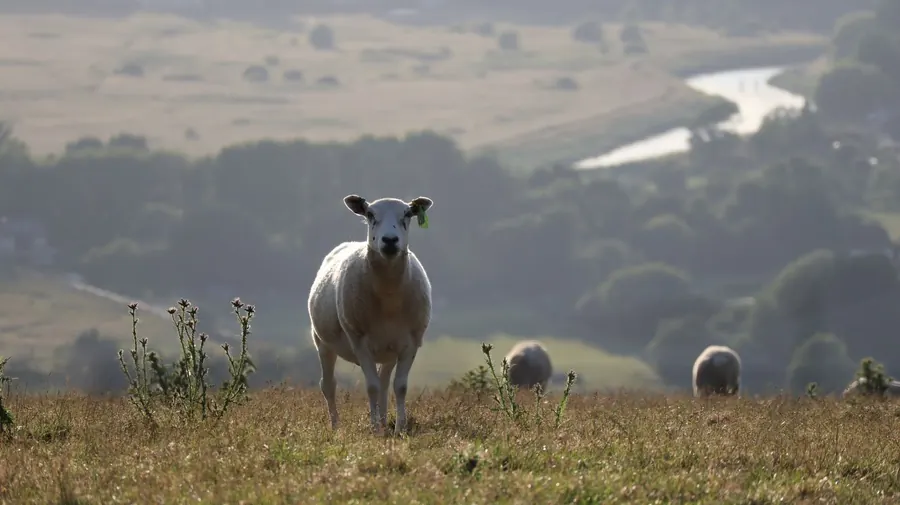
On a roof that means slow drying. Mist sits in the valley on autumn mornings, the north slopes of stone roofs stay damp for days, and moss builds up between the slates. Moss holds water against the stone and the oak pegs, and when the water freezes it splits slates and pushes them out of line. Trees along the beck and the river drop leaves into valley gutters and lead gutters behind parapets, and the overflow runs into the wall heads.
A roof down here doesn’t have to fail early, but it does need looking after more often. Clear the gutters and valleys after leaf fall, take the moss off before it lifts slates, and check the ventilation in a stone-slate loft. Breathable underlay helps, but a loft still needs some air moving through it.
Roof prices in Killinghall, Hampsthwaite and Birstwith for 2026
These are the ranges we see on our own jobs along this part of the valley. They include scaffolding, and where a re-roof is listed they assume a full strip, new breathable membrane and new battens.
| Work | Usual range |
|---|---|
| Replace rotten fascia, soffit and rafter ends on one elevation | £900 - £2,200 |
| Refix a few slipped stone or Welsh slates | £180 - £480 |
| Rebed a ridge in lime mortar on a stone cottage | £600 - £1,400 |
| Moss removal and gutter clear on a two-storey house | £250 - £550 |
| Re-cover a concrete-tiled house from the 1960s onwards | £7,000 - £11,500 |
| Re-slate a Victorian house in Welsh slate | £9,500 - £16,500 |
| Strip and re-lay a stone slate cottage roof | £17,000 - £34,000 |
Two things move a stone roof quote more than anything else. The first is how many of the old slates come off whole. Gritstone slates that survive stripping can be sorted by size and put back. Anything that breaks has to be replaced with reclaimed stone, which is expensive and getting scarcer. The second is the timber. A frame that has carried stone for a couple of centuries often needs a new purlin, sistered rafters or a new wall plate. Nobody can price that properly from the garden.
Further up the dale, exposure and steep access change the figures again. We explain why in our guide to roofers in Pateley Bridge and upper Nidderdale.
Barns, farmhouses and outbuildings between the villages
The farmland between Killinghall, Hampsthwaite and Birstwith brings a type of job you rarely see in Harrogate itself: the field barn or farm range that has been converted into a house, or is waiting to be.
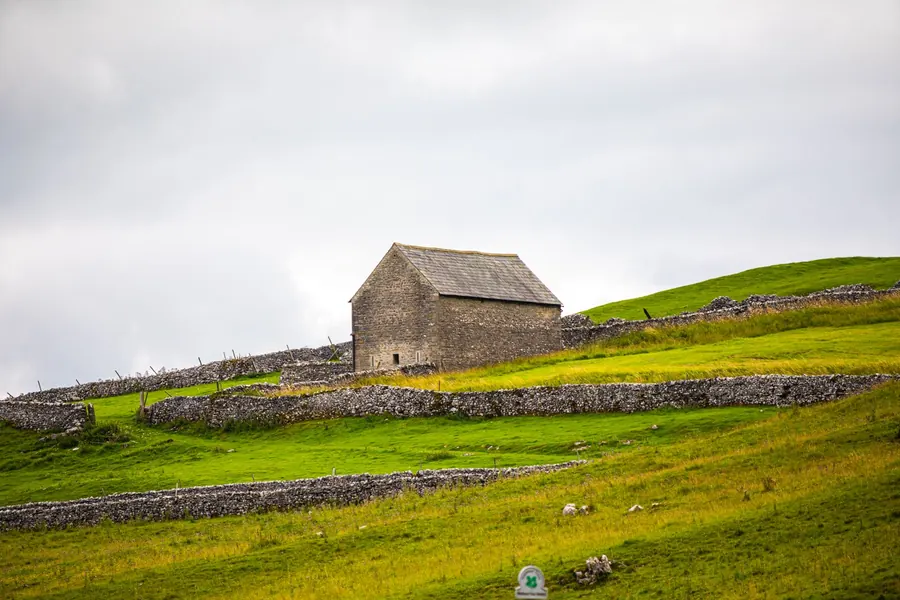
Old agricultural roofs are often the weakest part of the building. Some were covered in corrugated sheet or asbestos cement decades ago, and others still have stone slate on purlins that were never sized for a house roof with insulation added. When a barn becomes a house, the roof has to meet current building regulations for insulation and ventilation, and the extra build-up can raise the finished roofline. Inside the National Landscape, around Birstwith, the planners will look closely at materials and rooflights, so expect conditions on any approval.
If a barn or outbuilding still has an asbestos cement roof, have it tested before anyone cuts or drills it. Removing it is a licensed or controlled job depending on the material and its condition, and it adds both time and cost.
What to have ready before a roofer visits
You’ll get a more accurate quote if you can answer a few questions before the visit.
- Is the house listed, or in the Hampsthwaite conservation area? Check the council’s map. It takes two minutes and changes what a roofer can offer you.
- Do you want to change anything, such as adding a dormer or rooflight or switching to a different covering? Inside the National Landscape a dormer needs planning permission, so it’s better to know before the scaffold goes up.
- Can a scaffold lorry get to the house? Some of the older lanes in Hampsthwaite and Birstwith are narrow, and scaffold on the road or pavement needs a licence from the council.
- Who will sign off the building regulations? Either North Yorkshire Council’s building control service or a roofer registered with a competent person scheme. You’ll need that certificate when you sell.
- Has anything been done to the roof before? Old receipts, a past survey or photos of the loft all help a roofer judge the timbers before quoting.
We cover all three villages and the farms between them from Harrogate. If you’d like us to look at your roof, book a free roof survey in Killinghall, Hampsthwaite or Birstwith and we’ll arrange a time.
Frequently Asked Questions
Is Hampsthwaite a conservation area?
Yes. The old part of Hampsthwaite was first designated in 1976, and the boundary was changed in 1994 and again on 18 February 2009, when the current character appraisal was approved. It covers the historic core around High Street, Church Lane and the green, not the newer housing off Hollins Lane. Neither Killinghall nor Birstwith appears on North Yorkshire Council’s list of conservation areas for the Harrogate district.
Is Birstwith in the Nidderdale National Landscape?
Yes. Natural England’s boundary data puts Birstwith inside the Nidderdale National Landscape, the area designated as an AONB in 1994. Hampsthwaite sits right on the edge, with the boundary running close to the village along the River Nidd, and Killinghall is a few kilometres outside it. For an individual address, check the council’s map rather than going by the village name.
Do I need planning permission to re-roof my house in these villages?
Not usually, if you are replacing the roof in the same material and keeping its shape. That applies inside the Hampsthwaite conservation area and inside the National Landscape too. Changing the material, adding dormers or raising the roof is different, and inside the National Landscape a dormer loft conversion is not permitted development, so it needs a planning application. A listed building needs listed building consent for almost any roof change. Building regulations apply once more than a quarter of the roof is re-covered.
Which council deals with roof work in Killinghall, Hampsthwaite and Birstwith?
North Yorkshire Council. It replaced Harrogate Borough Council on 1 April 2023 and now handles planning, listed building consent and building control for all three villages.
How much does a new roof cost in Hampsthwaite or Birstwith?
Re-covering a concrete-tiled house from the 1960s onwards usually costs £7,000 to £11,500 with scaffolding. Re-slating a Victorian house in Welsh slate is more often £9,500 to £16,500. Stripping and re-laying a stone slate cottage roof tends to be £17,000 to £34,000, and the spread depends mostly on how many of the old slates survive and the state of the timbers.