
12 September 2026
Re-Roofing a Harrogate House in Stages: Front Slope Now, Rear Later
Roofers around Harrogate hear the same question several times a month, usually in the same slightly apologetic tone. The quote for the whole roof has landed somewhere between £6,500 and £9,500 for a concrete tiled semi, or past £12,000 if the house wears natural slate, and the money is not there in one lump. So could we do the front now and the back in a couple of years?
Often, yes. The problem is that the obvious arithmetic is wrong. Half a roof does not cost half the price, and the reason for that is standing in the front garden in a few tonnes of steel tube. Some costs split neatly down the ridge line. Others simply happen twice, and knowing which is which is the whole of this decision.
Why Harrogate homeowners end up asking about one slope at a time
The housing stock here pushes people towards this conversation more than it would in a town of newer estates. A large slice of Harrogate is late Victorian and Edwardian, so original roofs are now well past a hundred years old, and the nail fatigue that finally ends a slate roof does not arrive politely on both elevations at once. South and west facing slopes take the driving rain off the Pennines and tend to go first. North facing slopes hold moss and stay damp, but they often keep their fixings for years longer.
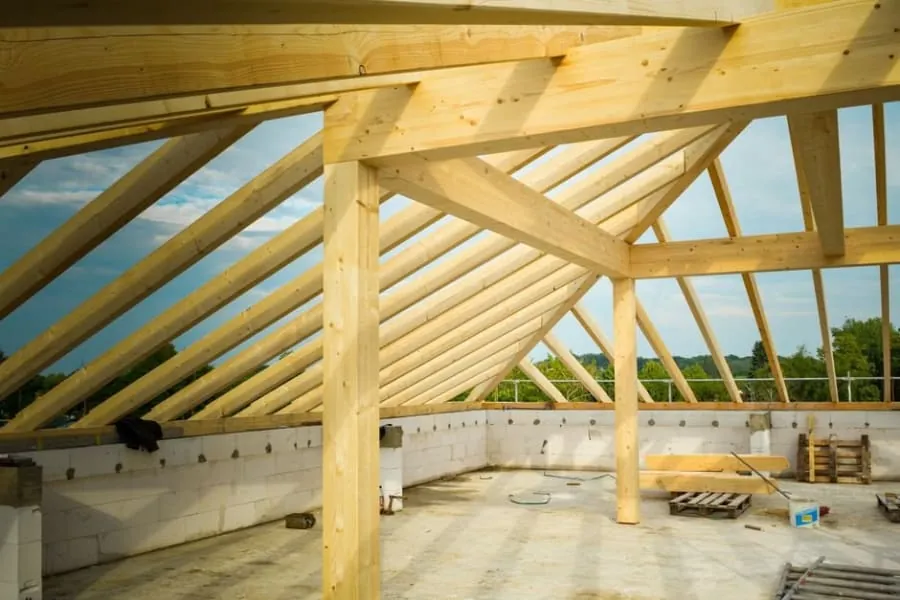
So it is common for a roofer to survey a house off Skipton Road or up towards Harlow Hill and report that one slope is failing now while the other has perhaps eight to twelve years left in it. That is not the same thing as a roof that is uniformly finished, and it deserves a different answer. A full roof replacement is the right call when the whole covering has reached the end of its life. When it has not, stripping sound slate to satisfy a sense of symmetry is a poor use of £4,000.
The trap is the third case. Both slopes are equally tired, nothing about the roof suggests splitting it, and the only thing dividing the job is the budget. That is the version most people mean when they ask.
The scaffold is the bill you pay twice
Almost everything on a re-roof is proportional to area. Tiles, battens, underlay, labour hours, waste, they all scale with the square metres you are covering. Scaffold does not. It is a fixed cost triggered by the decision to work at height at all, and it lands in full on each phase.
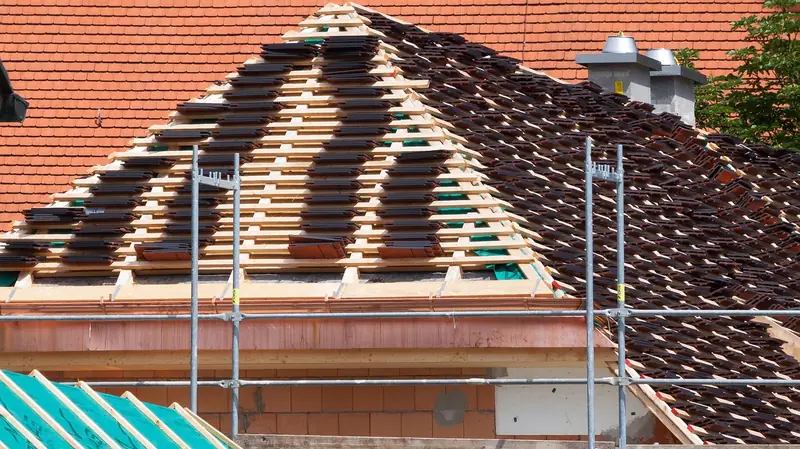
On a standard three-bed semi in Harrogate, a scaffold to one elevation typically runs £900 to £1,800 once you account for design, delivery, erection, the handover inspection, the hire period and striking it again afterwards. A detached house needing a full wrap sits closer to £1,800 to £3,000. Do the job in two phases and you are buying that twice, which on its own can wipe out a large part of whatever you thought you were saving. Our guide to scaffolding costs for roof work in Harrogate breaks down what sits inside that figure.
There is a second cost that catches people out on the terraced streets around Cold Bath Road and in central Knaresborough, where there is no front garden to stand the scaffold in. Putting it on the footway needs a licence from the council, and North Yorkshire Council’s scaffolding and hoarding on the road conditions make clear that a licence runs for up to four weeks at a time. Two phases means two applications, two fees and two rounds of waiting for the paperwork before anyone can start.
Matching the covering across a gap of two or three years
This is where phasing goes wrong most visibly, and the answer depends entirely on what is already on your roof. Settle it before you settle the running order. On some coverings it decides whether phasing is viable at all.
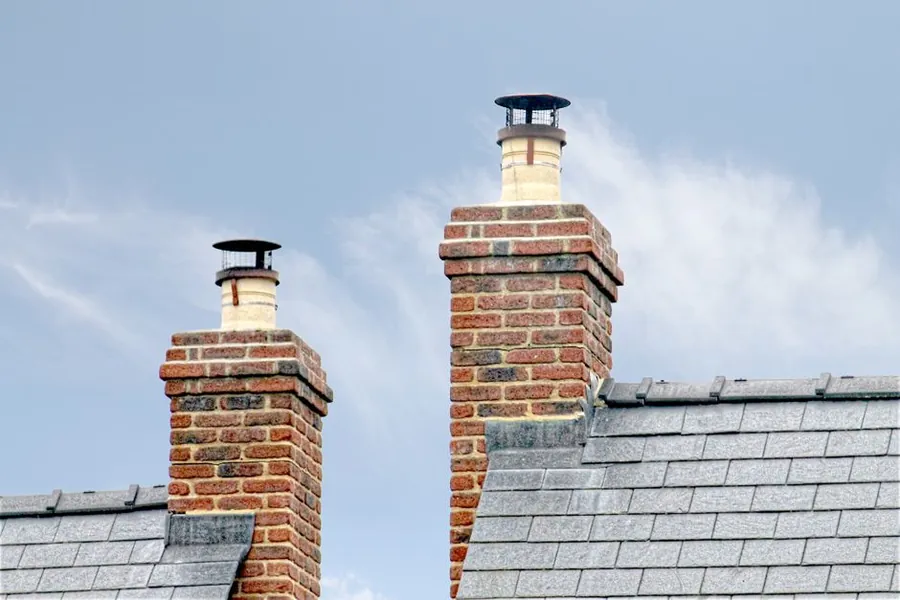
Concrete interlocking tiles are the worst case by a distance. The colour in a concrete tile is a surface pigment, and it fades and dulls fast in the first few winters, especially on a slope that gets any sun. Lay one elevation in 2026 and the other in 2028 and you will see the seam from the pavement for the best part of a decade. Manufacturers also revise profiles and drop colours without much warning, so there is a genuine chance the tile you used first time is no longer made when you come back for the rest. Buying the whole quantity up front and storing the second batch under a tarpaulin fixes both problems, assuming you have somewhere to keep roughly a tonne and a half of tiles for two years. Most people do not.
Natural slate and clay pantiles are far more forgiving. They weather rather than fade, and the variation within a single batch is already wide enough to swallow a two year gap.
Reclaimed Yorkshire stone slate is a different problem again. Colour is barely the issue here. Supply is. Salvaged stone comes onto the market when somebody else’s roof comes off, not when you happen to want it, and stone roofs are laid in diminishing courses with the biggest slates at the eaves, so you cannot just buy “some more” and expect it to sit right. We have gone through salvaging and re-laying Yorkshire stone slate in more detail elsewhere. On a stone roof the honest advice is usually to do the lot in one go, or not to start.
Where the join sits, and why the ridge is the only clean answer
A phased re-roof needs somewhere to stop, and on a simple gabled roof that place is the ridge. Nowhere else works. Stopping partway up a slope means leaving a horizontal joint in the underlay in the middle of the water path, which is exactly where you least want one, and no competent roofer will offer it.
Even a clean ridge join has one detail that has to be got right. The new underlay from phase one should be dressed over the ridge and lapped well down the old slope behind it, normally by not less than 150mm, so water running under the tiles has a continuous path off the roof. That means lifting the existing ridge tiles and a couple of courses on the untouched slope to tuck the new membrane in. Two years later the second phase undoes that same detail and rebuilds it.
So the ridge gets paid for twice as well, whether it is bedded in mortar or a dry system. Dry ridge is the more awkward of the two, because it is designed to run as one continuous length rather than as two halves bolted together at a later date.
Hipped roofs and anything with a valley are poor candidates for the same reason. A hip has no ridge to stop at on the sloping ends. A valley takes water off both sides at once, so splitting it leaves new and old materials sharing the busiest gutter on the building. On those shapes phasing usually stops making sense before you even get to the money.
What phasing actually costs against doing the lot
Here are the rough figures for a typical Harrogate three-bed semi with around 85 square metres of roof across both slopes, using 2026 guide prices. Treat them as a shape rather than a quote, because pitch, access, chimney count and whether the battens and timbers are sound will all move them.

Done in one visit, concrete interlocking tile lands somewhere around £6,500 to £9,500, and natural slate around £10,000 to £16,000. Split into two phases, the first slope will not come in at half. Expect roughly fifty-five to sixty-five per cent of the full price, because the scaffold, the skip, the delivery charges, the ridge work and the day the crew spends setting up and packing down are all in there regardless. The second phase then costs much the same again, minus whatever the first phase already paid for at the ridge. Across the two, most people end up fifteen to twenty-five per cent worse off than if they had done it once, and further adrift on smaller roofs where the fixed costs are a bigger share of the whole.
What that buys is time, not money. Paying £5,000 now and £5,500 in two years instead of £8,500 today is a worse deal in total and a better one for your cash flow. That is a decision about your circumstances rather than about roofing, and it is a reasonable one to make, as long as nobody is telling you it is the cheaper option. Price it against borrowing before you commit, though. On a five figure job the premium for phasing can quietly exceed the interest on a two year loan for the same sum.
Guarantees, building control and the paperwork nobody mentions
Two phases means two contracts. Nobody thinks about that at the quoting stage, and it has consequences.

Each phase gets its own workmanship guarantee, running from its own completion date. Your front slope is two years into its cover before the rear slope has even started. If the firm changes hands or stops trading in between, you end up with one guaranteed elevation and one that is not.
The join is the part to nail down in writing. If water shows up at the ridge in year four, is that phase one’s underlay or phase two’s? Use the same contractor for both, say so at the outset, and the argument never gets to exist. The NFRC’s guidance on choosing a roofing contractor is a reasonable starting point for working out whether a firm is likely to still be trading in three years.
There is a building regulations angle too. Re-covering a roof counts as renovating a thermal element, and once you pass the threshold set out in the government’s Approved Document L on conservation of fuel and power, the insulation has to come up to current standards. What matters is the proportion of the element you disturb, so a single slope and a whole roof can land on different sides of that line. Do not treat that as a loophole. Ring North Yorkshire Council building control before phase one and get their answer in writing. Finding out during phase two that both slopes needed upgrading is an expensive thing to discover with the scaffold already standing.
When phasing works, and when it is the expensive mistake
There is a version of this that just makes sense. One slope is failing, the other has a decade left, the covering is natural slate or clay, the roof is a simple gable, and you have no plans to touch the second elevation until it asks you to. That is not really a phased re-roof. It is a slope replacement, and you should price it as its own job rather than as half of something bigger.
It also stacks up reasonably well when a sale is on the horizon. Getting the visible front elevation done properly, with a guarantee and an invoice you can hand to a buyer’s surveyor, is often worth more at the negotiating table than it costs, and the rear slope becomes the next owner’s problem. Be straight about that in the paperwork rather than hoping nobody looks.
Where it goes badly is on concrete tiled roofs with both slopes equally worn, on hips and valleys, on stone slate, and anywhere the second phase is an intention rather than a funded plan. Every roofer in the area knows houses where phase two never happened. The old slope gave out three winters later, and the emergency repair cost more than doing the lot would have in the first place. If you cannot point to where the money for the second half is coming from, you are not phasing a re-roof. You are deferring one. Call it that, and plan around it honestly.
Frequently Asked Questions
Can you re-roof half a house at a time?
Yes, on most pitched roofs a single slope can be stripped and re-covered on its own, because the ridge gives the roofer a natural place to stop. The work is normal and no roofer will refuse it. What changes is the price per square metre, because the fixed costs of the job land twice, and the finish, because the two slopes will have been laid at different times with materials of different ages. Hipped roofs and anything with a valley crossing the middle are much harder to split cleanly.
How much more does it cost to re-roof a Harrogate house in two phases?
On a typical three-bed semi, splitting the work usually adds somewhere between fifteen and twenty-five per cent to the combined bill. The single largest item is the scaffold, which has to be designed, delivered, erected, inspected and struck twice, and on a semi that is commonly £900 to £1,800 each time. Add a second set of skips, a second mobilisation and a second minimum charge on materials and the gap widens further on smaller roofs.
Will the new tiles match if I leave two years between phases?
Concrete tiles will not. The pigment in a concrete tile sits at the surface and weathers noticeably within the first two or three winters, so a slope laid in 2026 will read lighter and cleaner than one laid in 2028 for years afterwards. Natural slate and clay pantiles age far more gracefully and are much more forgiving of a gap. Reclaimed Yorkshire stone slate is the awkward one, because the difficulty is supply rather than colour.
Does re-roofing in stages affect the guarantee?
It splits it. Each phase gets its own workmanship guarantee running from its own completion date, so the front slope starts using up its cover while you are still saving for the rear. The bigger issue is the join at the ridge, where old underlay meets new. Get both phases done by the same firm and ask, in writing, who owns a leak that appears at that junction. Two different contractors will each point at the other.
Is a phased re-roof ever cheaper than doing the whole thing at once?
Only when one slope is genuinely sound and does not need doing at all. If the rear elevation has fifteen good years left, re-covering only the front is not phasing, it is a sensible repair, and you avoid the second scaffold entirely by not planning a second phase. Where both slopes are failing, phasing always costs more in total. It buys you time rather than money.